We get asked this a lot:
“What is the difference between Naurt and What3Words?”
The simple answer is that we solve very different problems.
Naurt is built for delivery companies. It helps them understand the real-world context of an address, so drivers know where to go, where to stop, and how to complete the delivery faster.
What3Words is built to make a specific location easier to share using three words instead of a long latitude and longitude.
Both are location tools. But they are not solving the same use case.
Naurt works like an address lookup system, also known as a geocoder.
A normal geocoder takes an address string and returns a latitude and longitude. This is how checkout systems, mapping tools, and delivery platforms turn a written address into a point on a map.
Naurt does this too. But it goes further.
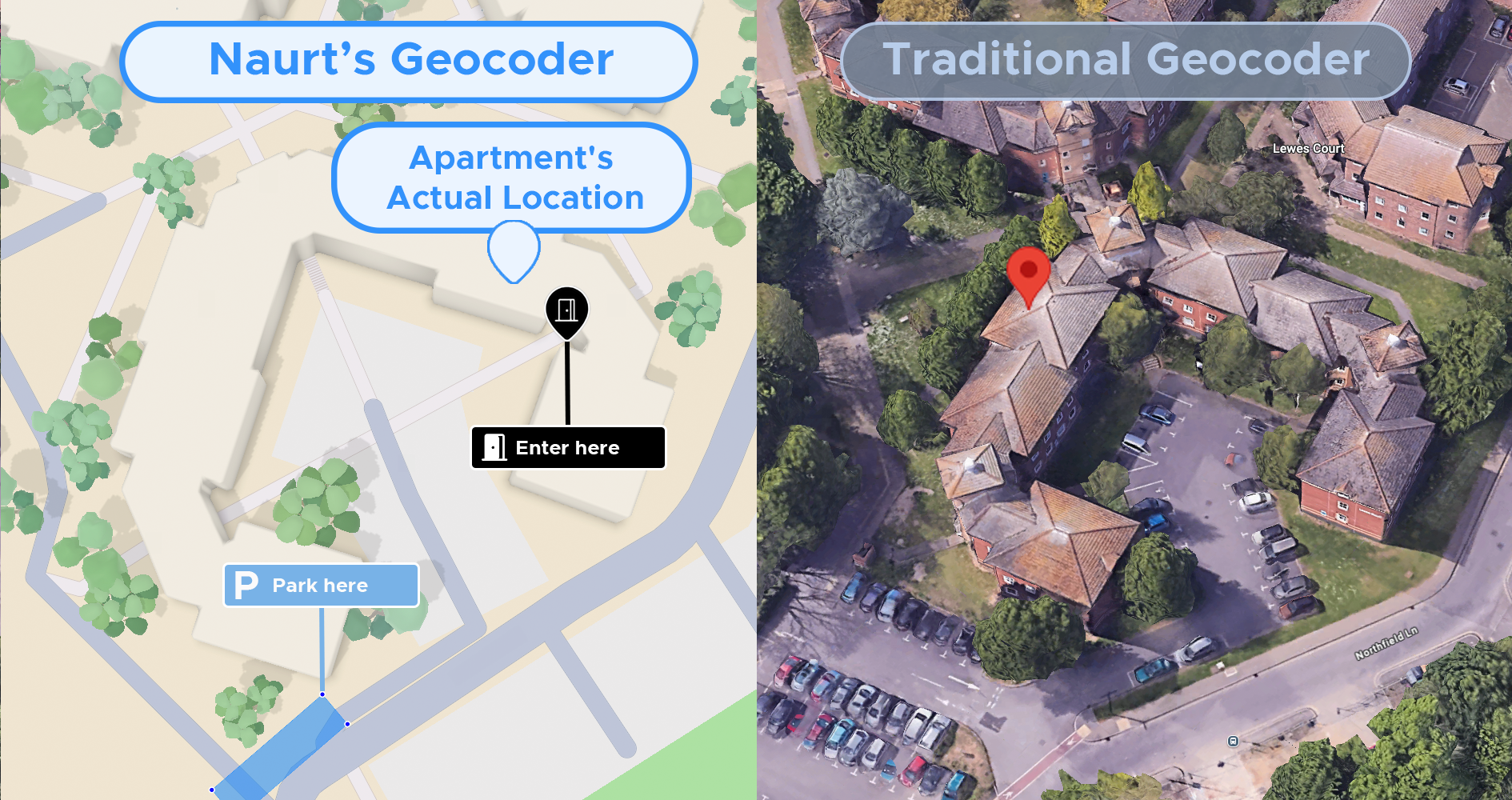
As well as returning the latitude and longitude for the address, Naurt can also return the latitude and longitude for the front door or entrance, the best place to stop or park, the centre point of the building, the building outline, the full address string, and the address match level.
This makes Naurt more useful for delivery companies. It does not just tell them where an address is. It helps them understand how to complete the delivery.
What3Words is different. It is a new way to share a location, but most people do not use it day to day because they already know their address.
It is useful in large spaces with no clear landmarks or addresses. For example, a spot in a park where you want to meet friends, or a place on a hill where you need emergency services.
In those cases, it is much easier to share three words with a person than a long latitude and longitude.

Naurt works like an address lookup system, also known as a geocoder.
A geocoder takes a written address and turns it into a latitude and longitude. Every checkout system, mapping tool, and delivery platform relies on this process in some form.
For example, a user might input:
The Grand Hotel, King Edwards Parade, Eastbourne, BN21 4EQ
A standard geocoder will usually return one point for that address.
Naurt returns that address location too, but adds more delivery context around it.
This can include the latitude and longitude for the building entrance, the best place to stop or park, the centre point of the building, the building outline, the full validated address string, and the address match level.
This matters because most delivery problems do not happen miles away from the address. They happen in the final 100 metres.
A driver may arrive near the building, but still need to work out where the entrance is, where to safely stop, and how to reach the customer. That can waste time on every route.
Naurt gives delivery companies the data they need before the driver arrives. This helps improve ETA accuracy, route planning, driver productivity, and the customer experience.
What3Words has divided the world into small squares and given each square a three-word address.
This makes it easier for people to describe a precise location without reading out a long latitude and longitude.
For example, it is much easier to say three words over the phone than to say:
50.760296, 0.283099
That is a long number. It is easy to mishear one digit. One small mistake can send someone to the wrong place.
This makes What3Words useful in places where there are no clear addresses or landmarks.
For example, if you are meeting friends in a large park, three words can help you describe the exact spot. Or if you break your leg on a hill and need emergency services, it can help you share your location quickly.
That is a strong use case.
But it is not the same problem Naurt is solving.
Naurt starts with the thing people already use every day: their address.
What3Words starts with a new way of describing a location.
That distinction is important.
Everyone knows their address. They use it when they order food, book a taxi, receive parcels, or sign up for services online.
Most people do not know the What3Words address of their home, office, flat entrance, loading bay, or preferred delivery point.
So for delivery companies, the practical question is not:
“How do we help customers describe a new type of location?”
It is:
“How do we turn the address we already have into better delivery instructions?”
That is where Naurt is better suited.
Naurt does not require customers to learn a new system. It works with existing address data and adds the missing delivery context on top.
E-commerce deliveries already begin with an address.
At checkout, the customer enters their delivery address. That address is passed to the retailer, then to the carrier, then to the driver.
This process is already built around addresses.
For What3Words to work in this flow, the customer would need to know the three words for their exact delivery point and enter them at checkout.
Most customers do not know this.
The retailer would then need to ask for it, validate it, store it, and pass it through to the delivery company. Delivery companies would also need to trust that the customer selected the right square.
That creates friction.
It also creates a chicken-and-egg problem. Retailers are unlikely to add a new field unless customers use it. Customers are unlikely to use it unless retailers ask for it.
Naurt avoids that problem.
The customer simply enters their address as normal. Naurt then enriches that address with the data needed to complete the delivery more efficiently.
This includes the latitude and longitude for the address, the building entrance, the best stop or parking location, the building outline, and other address-level context that helps delivery companies plan and complete the job.
Delivery companies do not just need a point on a map.
They need to know how to complete the delivery.
A location coordinate might tell a driver where a building is. But it does not tell them where to park, which entrance to use, or how to reduce time spent searching.
That is the gap Naurt fills.
Naurt is designed for operational use. It can plug into existing systems through an API or data file. It helps delivery companies improve the tools they already use, including checkout, routing, navigation, ETA prediction, and delivery planning.
The result is more useful than simply knowing a location.
It helps drivers make better decisions in the real world.
What3Words is useful when a person needs to describe a location verbally.
Naurt is useful when a business needs to improve how deliveries are planned and completed.
If you are lost in a field, What3Words can help you explain where you are.
If you are running an e-commerce delivery operation, Naurt can help your drivers find the right entrance, stop in the right place, and complete more deliveries each day.
That is the difference.
What3Words is a communication tool for people.
Naurt is address intelligence for delivery operations.
Both relate to location. But only one is built around the commercial needs of last-mile delivery.

Sign up at Naurt for product updates, and stay in the loop!


